
Check Wayne County's Current Owner Record
The local parcel folder is the primary record for present ownership. Read the owner field alongside the location and recording details rather than lifting one name out of context.
| Property Owner | The person, trust, estate, or entity on the current local roll |
|---|---|
| Mailing Address | The destination for assessment or tax notices, which may be elsewhere |
| Situs Address | The physical location of the Wayne County parcel |
| Parcel Number | The local key connecting assessment, tax, and GIS records |
| Last Sale | A date or transaction clue requiring deed confirmation |
| Deed Reference | The recording link when the municipal folder supplies one |
Treat the mailing address as a contact clue only. It does not prove where the owner lives. The situs address identifies the taxable parcel itself, and entity or trust names should be copied exactly as shown rather than converted to an individual.
Inspect a Wayne County Parcel Card
The sample BS&A property folder illustrates a typical local result. One Wayne County record separates the parcel number, Location ID, owner, values, building data, taxes, and property location.
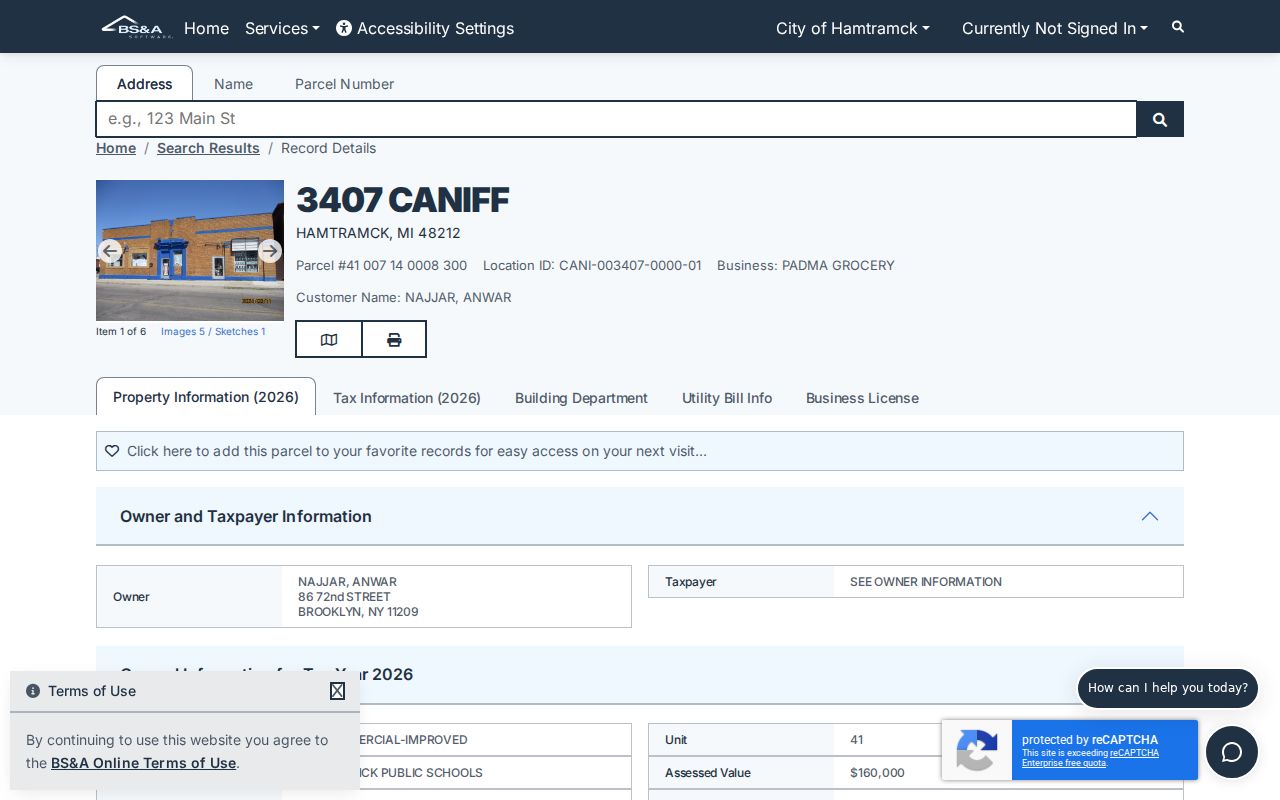
Keeping those fields apart prevents a common mix-up. Neither the tax mailing destination nor a local Location ID is the property's situs address or parcel number.
Check How Current a Wayne County Owner Record Is
Wayne County publishes no single update interval covering every municipal assessment roll. Local assessors keep the live data. County Equalization compiles annual figures from the prior December 31 and finalizes them after the March Board of Review. Use the county file for comparison. It is not a closing-day feed. For a recent closing, record the date you viewed the roll and compare the assessment owner with the newest recorded grantee. A mismatch can be ordinary processing lag. It can also point to the wrong municipality, parcel, or legal description, and the records themselves settle which explanation fits.
Recent-sale gap: A local roll can lag a transfer. The newest recorded deed may be more current, though neither an index row nor roll is a title opinion.
Confirm the Current Wayne County Owner
Work from today's assessment snapshot to the newest recorded transfer, not the full ownership history.
- Reach the correct local roll through the Wayne County assessment-data gateway.
- Copy the Property Owner field, parcel ID, situs, and legal description.
- Search that name in Wayne County Land Records and locate the newest matching deed.
- Compare the latest grantee, recording date, and land description with the roll.
- If the owner is an entity, verify its exact legal identity separately; if formal reliance matters, obtain the recorded document.
- Owner of record
- The party carried on the current assessment roll.
- Assessment roll
- The municipality's tax and valuation record, not a title report.
- Recording lag
- The period between a deed recording and a later local-roll update.
- Situs versus mailing
- The property location compared with the notice destination.
Verify Wayne County LLC and Trust Names
An LLC can be grantee and owner. Michigan's MiBusiness Registry searches entity names, individual associations, identification numbers, and filing numbers. A file there can show entity status, registered office, resident agent, and formation or filing data. That verifies the organization. It does not make the agent the owner. Trusts appear through trustee wording, and estates through an executor, administrator, or personal representative. Preserve that wording exactly. Probate records can explain the authority behind a deed, yet the ownership conclusion still rests on the matching land record and the current roll.
Reconcile the Wayne County Owner's Four Addresses
Four versions of one property's address deserve attention. Keep the postal or situs address, the assessor's version, the Treasurer search form, and the legal description on file. A mismatch can reflect street renumbering, a corner lot, a municipal boundary, a plat change, or a mailing arrangement. ZIP codes never define the taxing city. A postal city can differ from the roll. The Treasurer allows a blank municipality. The county search also recommends partial street names, and once the right parcel appears, carry its exact identifier and legal description back to the local owner record.
Note: Wayne County's parcel number is a cross-system key, but the recorded legal description remains the stronger land identity.
Build a Wayne County Current-Owner Confidence Ladder
Treat the "Property Owner" field as a starting lead, nothing more. Compare it against the most recent recorded grantee. Confirm both entries describe the same legal land. Check tax status or recorded liens where they matter. When the answer carries real weight, order a certified copy. The ladder builds confidence step by step. No web screen can guarantee title on its own.
Need more than the free recorder search? Wayne County sells address, parcel, legal-description, and liber/page searching. It also offers lobby kiosks, counter service, and mail search. Phone and fax research requests go unfulfilled by the office. A Michigan FOIA request can obtain an identifiable existing public record. Yet it cannot compel staff to build a title analysis for you.
Check Wayne County Tax and Encumbrance Context
The Treasurer lookup accepts an address or parcel ID and refreshes each business day. It can confirm that a parcel carries a delinquent-tax account. A taxpayer name never supersedes a deed. Neither does a payment record. Leave the municipality blank when unsure. You can also search the first three street-name letters without “Street” or “Avenue” for a broader match. Mortgages, assignments, discharges, construction liens, easements, and tax liens can sit beside the deed in the Register's index. These encumbrances may affect the owner's interest. They are not ownership transfers. A full property decision may still need court or title work.
Correct a Wayne County Owner Mismatch
Decide first which record is wrong or simply older. Bring the local assessor the parcel ID, legal description, newest deed reference, and the exact disputed owner or mailing field. A recorder indexing or document question belongs to the Register of Deeds. A permit portal's owner field is another administrative snapshot. It does not change recorded title. Detroit publishes an owner-correction route tied to proof of ownership. Other municipalities run their own assessment corrections. Across Wayne County, contact the custodian of the field rather than expecting the county Equalization compilation to overwrite a city or township roll.
Contact a Wayne County Property Owner Lawfully
A mailing address in the public record can serve an honest property inquiry. It reveals nothing about who actually lives there, though. It also grants no license to intrude. Treat occupancy as off limits. Michigan runs an Address Confidentiality Program that gives qualifying at-risk participants a substitute address with mail forwarding. Any protected physical address should be left alone entirely. A Wayne County property lookup identifies records, not a person's daily presence.
Lawful use. Contact a Wayne County owner only for legitimate property matters. Never use public records to stalk, harass, intimidate, or harm a person.
Need the broader method? See who owns a Wayne County property for the address-to-owner approach. A parcel card shows records. So does a deed index or an entity filing. None of them tells you who stands on the lawn each morning.
Michigan's Freedom of Information Act works as a written fallback for identifiable existing public records. It generally requires a response within five business days. A ten-business-day extension is permitted. FOIA cannot force an office to build a fresh ownership analysis or certify a database. So ask for something concrete. Name the parcel card, correction record, or deed-related administrative record you want. Send the request to the office that keeps it.
The Register of Deeds sets clear channel limits. The free route searches grantor and grantee names. It returns a document listing rather than a full image. The paid on-demand mode adds searches by address, legal description, parcel or tax ID, and liber and page. Lobby kiosks and counter service offer another path. A detailed mail search can be requested for an address. The office performs no property search by phone or fax. Call only to confirm access procedures. Note the date you checked along with the latest deed's recording date.