
Wayne County Property Value Types
Michigan assessment records carry several distinct value fields. None answers what a house is worth on its own. The active municipal roll supplies the current assessment figures. A deed may show the consideration stated in a transfer. A private appraisal answers a separate market question as of its own date.
| Value | What It Is | Where |
|---|---|---|
| Assessed value | One-half of the assessor's estimate of true cash value under Michigan's assessment level | Local city or township roll |
| State Equalized Value | Assessed value after county and state equalization | Assessment record |
| Taxable value | The capped figure used in the property-tax calculation, subject to Michigan rules | Assessment and tax record |
| Last sale price | Transfer amount reported on the parcel card or consideration shown in an instrument | Local roll and recorded deed |
| Land and improvements | Components that may explain how the assessor allocated value | Municipal parcel card |
Michigan law pegs assessed value at 50 percent of true cash value. It is not half of a guaranteed sale price. Equalization, appraisal dates, and market evidence shape the roll. Taxable value follows its own capped path and can drift far from SEV over the years.
Local Wayne County Value Rolls
Wayne County keeps no single live assessor roll. Its 43 communities prepare local assessment rolls. County Equalization compiles annual files after the March Board of Review, and the county cautions that those downloads are retrospective. For a present Wayne County property value, start with the city or township record. The Wayne County Assessment Data page links municipal BS&A folders, annual CSV data, GIS files, tax tools, and the deed system. Think of it as a switchboard. It is not the sole custodian. Note the municipality, parcel number, assessment year, and date observed, so a later reader can tell which roll produced the figure.
Read Wayne County Assessment Fields
A BS&A folder can show the owner of record. It also lists the parcel number, location ID, assessed value, taxable value, and prior-year figures. Building details and tax or permit tabs appear where the municipality participates. The field labels matter. A bare number without context means little. The sample Wayne County municipal parcel card shows one result. It groups identity, assessment, tax, sale, and building data in a single view.
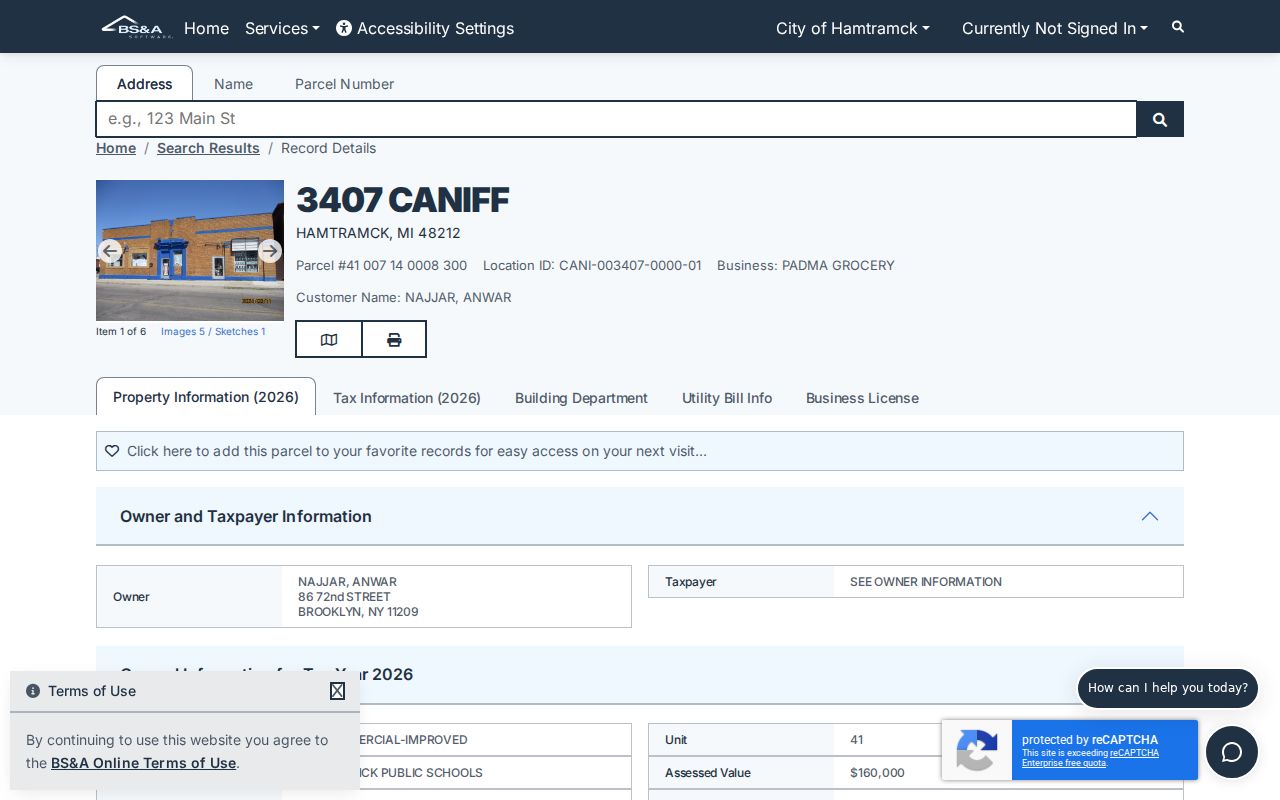
The mailing address is not the property address. Check that detail first. Then confirm whether the sale entry describes an arm's-length sale, a family transfer, or another event before using it as a market comparison.
Wayne County SEV and Caps
State Equalized Value, or SEV, is the assessed figure after equalization. Taxable value is different. It drives the actual tax calculation. It is generally capped each year by the lesser of inflation or 5 percent, plus permitted additions and losses. A transfer of ownership can uncap taxable value the following year under Michigan rules. That is why two similar parcels can diverge. Their SEVs may match, while their taxable values differ sharply.
- True cash value
- Michigan's legal measure of a property's usual selling price, subject to statutory valuation rules.
- Assessed value
- The local assessment, generally set at 50 percent of true cash value.
- SEV
- The assessed value after equalization.
- Taxable value
- The capped tax base used with millage rates.
- Reassessment
- A new review of value for an assessment year, not a private sale appraisal.
Wayne County Sale Price Evidence
A sale field on the assessor card is quick. The recorded instrument gives the land-record context. Match the parcel ID, legal description, grantor, grantee, instrument date, and recording reference before relying on it. A quitclaim, sheriff's deed, executor's deed, or transfer into a trust may not resemble an ordinary open-market purchase. Wayne County Land Records offers a free grantor and grantee name search. Expanded address, legal-description, parcel-ID, liber/page, image, and printing functions move to the on-demand service or to the office and mail routes. The published online search-service cutoff is January 1, 1960. The maintained index reaches much farther back. A stated price is evidence, not a value.
Look Up Wayne County Values
Keep each source in its lane. Use the municipal card for assessment fields. The broader Wayne County property tax records page covers bills, exemptions, and appeals; pull the recorded deed only when transfer evidence matters.
- Select the correct city or township through the county Parcel Information Search.
- Search by address, then verify the parcel number and legal description.
- Record assessed value, SEV, taxable value, year, exemptions, and land or improvement fields shown.
- Compare the sale entry with the latest recorded instrument when transfer context matters.
- Use a licensed appraisal for a current, property-specific market opinion.
- Assessment ratio
- The relationship between assessed value and true cash value; Michigan uses a 50 percent level.
- Sale consideration
- The amount stated or reported for a transfer, which may not represent an open-market price.
- Revaluation year
- The assessment year attached to the value, which is essential when comparing records.
Citywide Wayne County Context
Official Census QuickFacts offers citywide context, not parcel estimates. Its 2020 to 2024 median owner-occupied values run $76,100 in Detroit, $211,500 in Dearborn, and $242,600 in Livonia, summarizing occupied homes across each city. They cannot price a neighborhood, street, or single parcel. City systems differ too. Detroit's assessor runs its own active roll and review process. Dearborn uses BS&A for property and permit services. Livonia's property inquiry separates summer and winter periods and may show special assessments. Record the local source and year rather than treating Wayne County as one uniform value market.
Current and Retrospective Values
A live local roll and a Wayne County Equalization download answer different questions. The live card leads for the current assessment year. County annual files are stronger for reviewing a prior snapshot or for comparing many parcels on the same basis. Formal reliance still demands a certified record.
Keep the year attached. A value without its assessment year, municipality, parcel ID, and observation date can be misleading when rolls update or ownership changes.
Some records look like valuation evidence but are not. A Principal Residence Exemption trims school operating tax. It helps qualifying owners, yet it never changes what a property would sell for. A permit or zoning approval can explain planned work. It does not prove the work was ever finished. Context helps. Evidence takes more.
To compare values across years, hold the parcel, municipality, assessment year, and field constant. A split, combination, new construction, demolition, exemption change, or transfer can snap a trend in two. Compare the land and improvement components to see where the roll moved. When the public card stays silent, the assessor should explain the change. Save a downloaded copy of the county data. It serves as a snapshot, so pull a fresh local card for the current roll state. Keep both.
Wayne County Value Limits
Assessment is mass appraisal built for administering property taxes. It sweeps across many parcels at once. It can lag a fast shift in sale conditions or in a property's physical condition. It also cannot prove title, boundary location, permit completion, or the condition of a building.
Value is not price. A Wayne County assessed value is not what a property will sell for and is not an appraisal. Use a licensed appraiser for a current market opinion.
For real due diligence, set the parcel card beside the relevant deed, the current physical facts, and well-matched sales. Need an official value record? Contact the local assessor, or file a written Michigan Freedom of Information Act request for an identifiable record not available otherwise.
Name the value you cite. Saying "the county says it is worth" hides whether the figure is assessed value, SEV, taxable value, stated consideration, or a citywide statistic. Precise labels make any comparison useful.
Check Michigan Transfer Rules Before Comparing Values
A sale can move taxable value in the following year. Check Michigan Treasury's transfer-of-ownership guidance before comparing a buyer's tax record with the seller's. A changed taxable value is not a market appraisal. The local assessor should confirm how the rule applies to the parcel.