
Wayne County Deed Records by Instrument
The Wayne County Register of Deeds handles recorded interests touching nearly 900,000 parcels. Deed type reveals how a transfer was framed; the full instrument carries the parties, execution language, legal description, and recording references.
| Deed Type | What It Does | Common Use |
|---|---|---|
| Warranty deed | Conveys the stated interest with warranties in the instrument | Ordinary purchase transfer |
| Quitclaim deed | Conveys whatever interest the grantor holds without the same warranties | Family, estate, or interest cleanup |
| Land contract | Records an installment land-purchase arrangement | Seller-financed acquisition |
| Executor or administrator deed | Transfers property through estate authority | Probate disposition |
| Sheriff's deed | Documents a transfer arising from a foreclosure process | Completed foreclosure transfer |
Mortgages, assignments, discharges, construction liens, leases, easements, tax liens, and plats sit beside deeds in the land index. Many affect the property without transferring ownership at all. Check the document type before slotting an index row into a title chain.
Search Wayne County's Recorder Portal
The official Wayne County Land Records service splits free access from expanded access, and that split shapes where a property search should start. The official land-record screen offers a free party-name route alongside expanded account access.
That visible mode split is why address-only researchers need a parcel card or on-demand access to get anywhere.
| Mode or field | Access | What it does |
|---|---|---|
| Grantor or grantee name | Free public mode | Returns a document listing, not the image |
| Address, parcel ID, legal description | Paid on-demand account | Expands searching beyond a party name |
| Liber and page | Paid mode or office | Retrieves a known recorded reference |
| Document image | Paid online or counter | Shows the complete instrument when available |
| Certified copy | Office or mail | Certification is not available online |
Names trip up searches. Initials, entity suffixes, misspellings, trustee language, and "estate of" wording all change what the index returns, so lean on the legal description and recording reference to separate same-name parties.
The 1703, 1960, and 1986 Record Markers
Three dates describe different things, and each one matters. The Register's own history points to a maintained land-transaction index reaching back to 1703. That same history notes an archive of more than 50 million pages. The current search-services page sets online searching and printing at January 1, 1960 and after. The office history names 1986 as the year technology began enhancing recording and indexing. None of these compete. One marks index depth, one marks online coverage, and one marks an imaging milestone.
An index entry does not promise an image. Pre-1960 deed records call for the office itself. That means mail research, microfilm, hand indexes, and deed or plat books. The Library of Michigan land-research guide can help. Archival aids extend the picture well past the online window too.
The Archives of Michigan Wayne County guide can point to probate, tax, and assessment series. Those series may explain a name or land reference in an old deed. Detroit Public Library directories and Sanborn maps can anchor a former address to its era. These aids steer the next deed-book or plat search; the recorded instrument still rules.
Label each date for what it is. Treat 1703 as index depth. Treat 1960 as the published online cutoff. Treat 1986 as a technology milestone. That habit keeps a broad historical claim from implying every old image is a click away.
Walk the Wayne County Grantor-Grantee Chain
Start with the current assessor owner and the exact parcel number or legal description. A backward walk follows each transfer in turn rather than just collecting documents with similar names.
- Find the newest deed in which the current owner appears as grantee.
- Read the grantor, deed type, legal description, recording date, and liber/page or instrument number.
- Search that grantor as an earlier grantee and verify the same land description.
- Repeat until the web coverage ends, then continue through office or archival indexes.
- Grantor
- The indexed party transferring an interest.
- Grantee
- The indexed party receiving an interest.
- Chain of title
- The connected sequence of instruments affecting one legal parcel.
- Liber/page or instrument number
- The recorded locator used to retrieve a specific filing.
When a Wayne County Chain Changes Shape
A clean sale-to-sale chain can break at probate, survivorship, trust administration, foreclosure, or a land contract. When a grantor shows up as an estate, executor, administrator, or trustee, check the public court index and County Clerk records to confirm the authority. Then return to the recorded instrument. Pair every mortgage and lien with its assignments and discharges rather than treating them as transfers.
The Third Judicial Circuit's Odyssey Public Access offers a register of actions for public cases. Filed documents are not viewable there. The web result is unofficial. For the complete record, the clerk counter or archive is the place to go.
Wayne County Clerk civil records run from 1942 to the present. Files from 2010 forward can be viewed in the records room. Older files may need retrieval from Archives. They are held five calendar days after delivery. Requests work at the counter, by mail with a money order, or by email after the specified payment process. An uncertified Xerox copy runs $2 per page.
For probate-linked transfers, start at the latest deed. Note every executor, administrator, estate, trust, or survivorship phrase. Search the public case index for the proceeding. Pull the file from the clerk if needed. Then return to the Register index. The court file explains the authority. The recorded deed remains the land-record link.
Property Alerts and Wayne County Deed Fraud
Wayne County takes deed fraud seriously. The county's Mortgage and Deed Fraud Unit dates to 2005. The land-record system became fully functional in 2007. The Register now links a free Neumo Property Alert. It watches a personal or entity name, a keyword, or a filing selected from a found document. Alerts can surface tax liens, releases, or suspicious attempts. The hosted service does not guarantee complete or uninterrupted notice, though. An alert is monitoring, not prevention or title insurance. Suspected fraud goes to the county Fraud Unit at 313-224-5869.
Obtain a Wayne County Deed Copy
Getting a deed copy starts with choosing a route. Online on-demand access is sold in 15-minute increments at $6 plus applicable fees. Online printing runs $2 per page. In person, the published search charge is $5 per property. That fee is waived with proof the search covers your own residence. Plain copies cost $2 per page. Certification adds $10 per document. Lobby kiosks run during published office hours, 8 a.m. to 3 p.m.
A mail search costs $15 per address. The check is payable to Wayne County Register of Deeds, 400 Monroe, 7th Floor, Detroit, MI 48226. Include a detailed property description with the request. The office does not conduct searches by phone or fax. Appointment and fee policies changed in 2025 and 2026, so verify current service before traveling.
Recorded, not guaranteed. Wayne County deed records show filings accepted into the public record. They do not resolve every unrecorded interest or provide a title opinion.
Match Wayne County Deed Records to Other Files
A deed search gets stronger when each instrument is checked against the local assessment card, parcel map, and tax status. Start with the legal description. A street address alone is not enough. The municipal parcel number works across assessor, Treasurer, and GIS systems, but it is only an administrative identifier. Lot, block, subdivision, metes-and-bounds, liber, page, and document number are the durable links inside Wayne County deed records.
The index may show more than transfers. A mortgage, assignment, discharge, construction lien, easement, lease, tax lien, or sheriff's deed can sit beside them. Record the document type and its instrument reference first. A mortgage shows an encumbrance, not a new owner. A discharge may release a recorded interest. A quitclaim deed can convey an interest without the warranties a warranty deed carries.
If the chain reaches an estate, trust, foreclosure, or court order, follow the Third Judicial Circuit or County Clerk route to understand the authority. Odyssey shows public case activity. It does not display filed documents online. Request the actual file from the Clerk, then return to the latest recorded deed. For older chains, the Archives of Michigan guide, deed books, plats, microfilm, and library land-research aids extend the trail.
Formal reliance requires the proper copy. The county publishes $2 per page for copies and $10 per document for certification. Online certification is unavailable. Confirm the current fee and service method before ordering. Keep the index row with the image or certified copy so names, roles, recording date, document number, and land description stay tied together.
Check Current Wayne County Recording Access
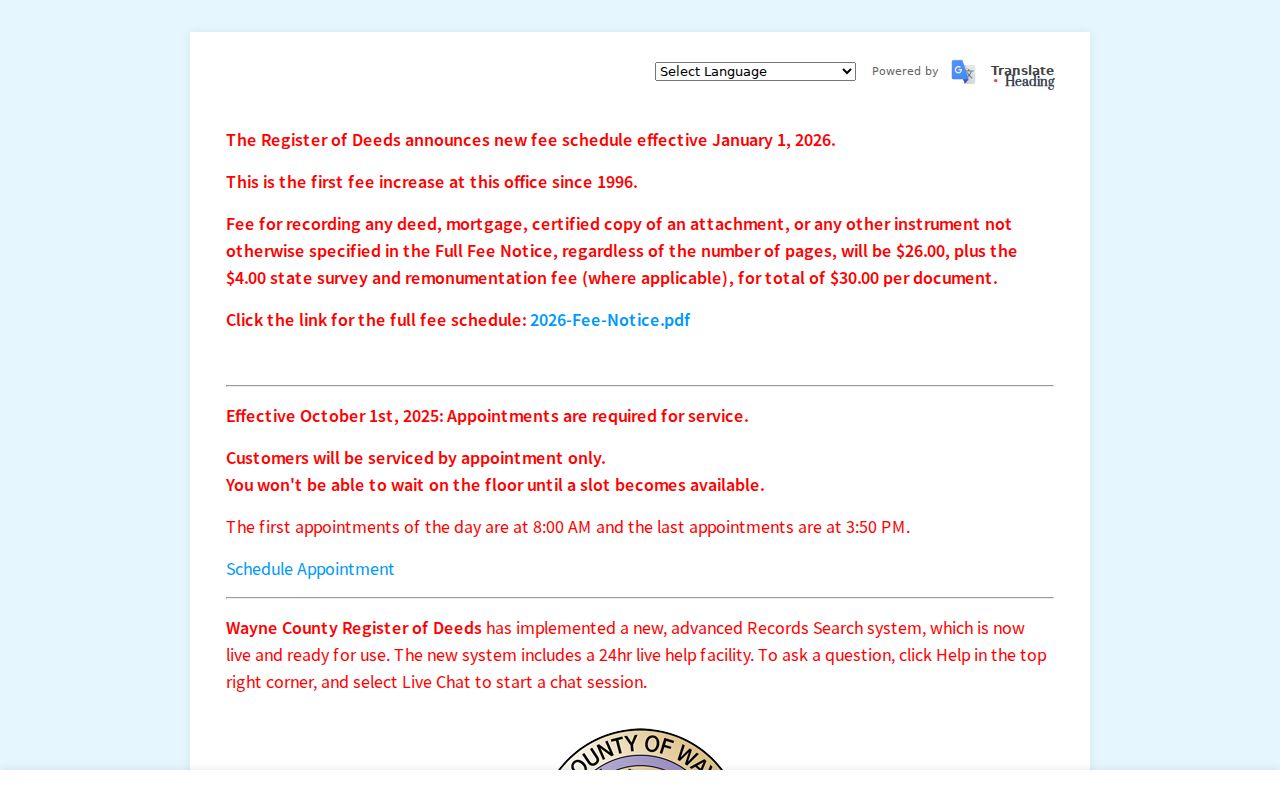
The Register announced a recording-fee change effective January 1, 2026. The office also began an appointment policy on October 1, 2025. The notice describes appointment lengths based on document volume. Those rules govern service and new recordings. They do not change the historic index dates. Appointment slots and charges can shift, so check the official office page before visiting.
Search access and recording service are separate. A person tracing an old deed may use the public index, paid on-demand mode, lobby kiosk, or mail route. No document needs presenting for recording on those routes. Say which service you need when you contact the office. That way the answer covers search, copies, certification, or a new filing.