
Fields in Wayne County Property Tax Records
Two levels feed the record. The local assessor keeps the current assessment and tax roll. County Equalization compiles the annual countywide data, while the County Treasurer handles delinquent real-property taxes after local collection ends.
| Field | What It Shows | Where |
|---|---|---|
| Assessed value | One-half of estimated true cash value under Michigan's assessment framework | Local assessor roll |
| State Equalized Value | Assessed value after equalization | Local roll and county compilation |
| Taxable value | Capped value used in the tax calculation | Local assessor and bill |
| Principal Residence Exemption | Qualified owner-occupied property may receive up to an 18-mill school operating exemption | Local assessor |
| Delinquency and payment | Outstanding county-held taxes and status | County Treasurer |
Assessed, equalized, taxable, and sale values answer different questions. Taxable value drives the bill. Exemptions and millage rates finish the calculation, and the result is not a market appraisal or the consideration recorded on a deed.
Wayne County's Split Assessment Roll
The Wayne County Assessment and Equalization office oversees a split system. The 43 local communities each prepare their own assessment and tax rolls. The countywide annual files are retrospective. They reflect December 31 of the preceding year and are finalized after the March Board of Review. For a current value, a correction, an exemption, or any property-tax question, go local. The local city or township assessor controls the record.
The county's Assessment Data page works like a switchboard. It connects visitors to municipal BS&A records, the Parcel Viewer, a tax estimator, the Treasurer, annual CSV files, and land records. County data is useful for comparisons. It should not displace the current local roll.
The county's successful assessment screenshot illustrates this switchboard. The Treasurer image below shows the separate delinquent-tax route.
Equalization also publishes municipality-filtered annual files, historical tax maps, and historical GIS parcel-layer shapefiles. Those downloads help compare past rolls or study a wider area. A custom export may carry an added charge. It can be requested through the county's data or Freedom of Information Act route. Always keep the file year with a copied value.
A current portal result and an annual county row may both be accurate for their own observation dates. If they differ, ask the local assessor about a correction, Board of Review action, parcel split, transfer, or later roll update. That may explain the change. Do not combine fields from separate years into one apparent property-tax record.
The official Treasurer search form displays address and parcel tabs with municipality selection.
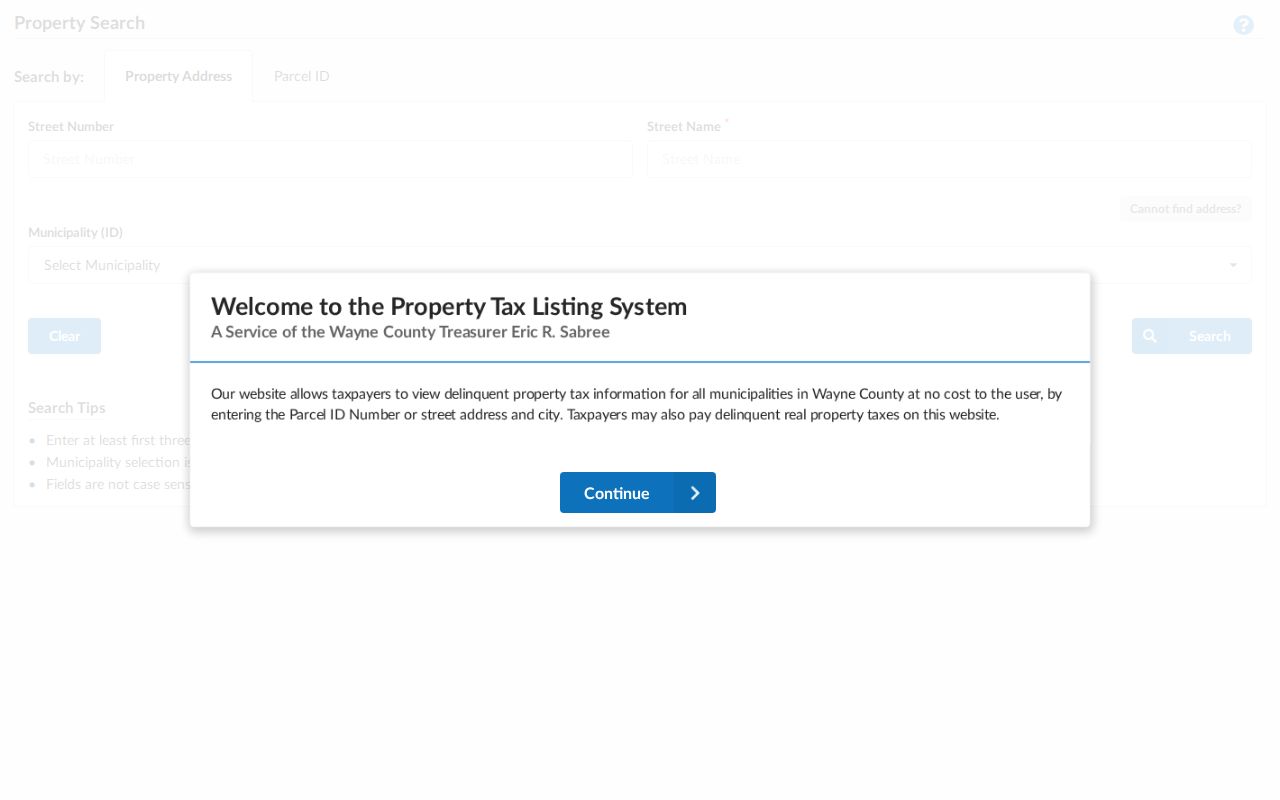
Detroit and non-Detroit parcel numbers get entered differently there.
Search the Wayne County Treasurer Form
Delinquent taxes get their own tool. The free Treasurer property-tax listing accepts either a Property Address or a Parcel ID and updates once each business day.
| Input | Format | Search tactic |
|---|---|---|
| Street number | Optional numeric field | Leave blank to list a street |
| Street name | At least the first three letters | Omit Street or Avenue for a broader match |
| Municipality | Dropdown, optional | Leave blank when the taxing city is uncertain |
| Detroit parcel ID | Separator at ninth digit; suffix may appear | Preserve the period or dash |
| Non-Detroit parcel ID | Generally 14 to 16 characters | Use no spaces or dashes |
Look Up a Wayne County Tax Bill
Label every lookup with its tax year. Carry the municipality, parcel number, and source alongside it, since current local taxes and county-held delinquency mark different stages of the same property.
- Find the current municipal parcel card by address and copy the parcel ID.
- Read assessed, State Equalized, taxable value, and exemption fields for the same year.
- Search the Treasurer listing by the formatted parcel ID or address.
- Check delinquency, forfeiture, foreclosure, and auction records separately before drawing a conclusion.
- Assessed value
- The local assessor's statutory valuation, generally 50 percent of true cash value.
- Millage
- A tax rate expressed per thousand dollars of taxable value.
- Principal Residence Exemption
- Michigan relief from up to 18 mills of school operating tax for qualifying principal residences.
- Tax lien
- The governmental claim arising from unpaid property tax.
When a Transfer Uncaps Taxable Value
Proposal A caps annual taxable-value growth for property that has not transferred. The cap is the lesser of inflation or 5 percent. A transfer of ownership can uncap it in the following year. Taxable value then rises to State Equalized Value before a new cap begins. That explains a recent buyer's bill. It can differ sharply from the seller's. The millage may not have changed at all. Not every deed event counts as a statutory transfer. Use the state's change-of-ownership guidance and the local assessor for the parcel rather than predicting uncapping from a deed label alone.
Wayne County Delinquency and Foreclosure Stages
Unpaid local taxes then move to the county process. The Treasurer lays out delinquency, forfeiture, foreclosure, auctions, and tax certification on its Property Tax Information page. Forfeiture is one stage. A published foreclosure notice is another. Neither proves an auction happened or that title transferred. Check the case stage, redemption status, deed record, and current roll. The county also publishes forfeited-property lists. Those lists cover current and historical years, and foreclosure statistics appear alongside them. Its 2026 Claims and Auctions material covers surplus-proceeds claims under MCL 211.78t, including Form 5743 and a July 1 notice deadline after effective foreclosure. That claim process relates to the foreclosure record but never substitutes for checking title.
Stage matters. A delinquent listing, forfeiture, foreclosure judgment, auction, and recorded transfer are separate events; identify which one the official record documents.
Apply Michigan's Principal Residence Exemption
The Principal Residence Exemption can remove up to 18 mills of local school operating tax. Ownership and occupancy requirements apply, and it changes the bill rather than market value. Michigan Form 2368 is the affidavit route. Filing and correction questions go to the local assessor whose roll carries the parcel.
A wrong or missing tax-bill name goes to that assessor too. The Register of Deeds records transfers. It does not update municipal tax billing on request.
Record the exemption status and tax year exactly as displayed. An exemption shifts eligible school operating tax. It never changes the owner, mapped boundary, or sale price. If the status looks wrong, save the current record. Ask the city or township assessor about the affidavit or correction procedure. The County Treasurer cannot alter the assessment roll.
Appeal a Wayne County Assessment Locally
Your assessment appeal starts locally. The city or township handles the first review, not County Equalization. The assessment notice shows the filing window. It also lists the required form and the Board of Review schedule. Read it closely. Strong support can include the parcel card, photographs, an appraisal, comparable sales, and evidence of the building's condition. Add a short written explanation of the disputed field.
Detroit's 2026 calendar shows how much these deadlines vary by municipality. Assessor Review ran February 1 through 22 with online, in-person, and mail submissions. The Board of Review followed in March. Filing there asked for a name and address or parcel number. It also asked for the reason, supporting material, and contact information. Other Wayne County municipalities build their own procedures.
Appeal window. Use the deadline on the current local notice. A prior Detroit calendar or county data-release date does not establish another municipality's filing window.
Document a Wayne County Property Tax Record
A good tax file holds more than the balance. Save the municipality, parcel ID, property address, and roll year first. Add assessed value, State Equalized Value when shown, taxable value, and exemption status. Note the bill status, delinquency, and observation date. These fields come from different public systems. Label each source so nobody mistakes them for one synchronized record.
The County Treasurer also sells formal tax services. Tax certification costs $5 for up to 25 parcels. A paid tax statement runs $3 per item per year, and a tax search or abstract costs $3 per year. Photocopies are $1 per page. The TARA electronic-file route is priced per tax year with a 100-parcel minimum. Confirm current terms with the office before ordering.
Foreclosure work needs the stage and date. Wayne County publishes forfeited-property lists, historical foreclosure material, tax-sale information, and claims guidance. A forfeiture notice is not a finished auction. An auction listing is not the recorded transfer either. Compare the Treasurer status, any court or notice record, the latest deed, and the current municipal roll before describing ownership.
For formal use, ask the custodian for a certified record instead of a screenshot or ordinary portal print. A local tax bill, a Treasurer certification, an assessment decision, and a recorded deed answer different questions, so note the property year and municipality every time to keep an old value or delinquency from masquerading as the current account.
Keep Wayne County Tax Years Separate
Wayne County's annual assessment downloads make year-to-year comparison easy. The local assessor should explain the present record. A transfer can uncap taxable value, an exemption can change eligible school operating tax, and a Board of Review decision can rewrite the roll. Never infer those events from a changed total. Keep the notice, decision, bill, and record year together in one file.
A current municipal roll, the prior December 31 county snapshot, and the Treasurer's once-per-business-day delinquent listing can each show a different stage of the same parcel. Record the date and source of each. If a number will support an appeal, closing, or formal statement, go to the custodian for the matching notice, bill, decision, or certification. The paper beats memory.