
Identify Who Owns a Wayne County Property
Every ownership check begins at the parcel card and ends at the deed. Wayne County Equalization maintains the index of municipal property folders. Each community, though, keeps its own live assessment roll with its own BS&A parcel data.
- Use the Wayne County Parcel Information Search to reach the correct municipal BS&A or assessor system.
- Search the situs address and copy the displayed owner, parcel ID, legal description, and municipality.
- Search the owner as grantee in Wayne County Land Records and identify the newest deed matching the same land.
- If an LLC appears, check its legal identity in Michigan's MiBusiness Registry. A registered agent is not necessarily the property owner.
- For a conclusion that will be relied on formally, order the recorded deed or a certified copy from the Register of Deeds.
Each record plays a single role. The roll shows the current tax snapshot; the deed records a conveyance; the business registry explains an entity name. Only a title opinion settles ownership with legal force, and none of these sources is that.
Read Wayne County's “Property Owner” Field
On a Wayne County BS&A parcel card, the line labeled “Property Owner” is separate from two other addresses. One address shows where the parcel actually lies. The other shows where the tax bills get mailed. The name printed there can take several forms. It might be one person, a married couple, an estate, a trust, or a company. Reading it as proof of residency is a mistake. Plenty of owners get their mail somewhere else entirely. Plenty of occupants hold no title interest at all.
The sample Wayne County BS&A record shows how one parcel folder gathers everything together. It holds the owner and parcel number, the assessed value, tax details, building data, and the property's location.
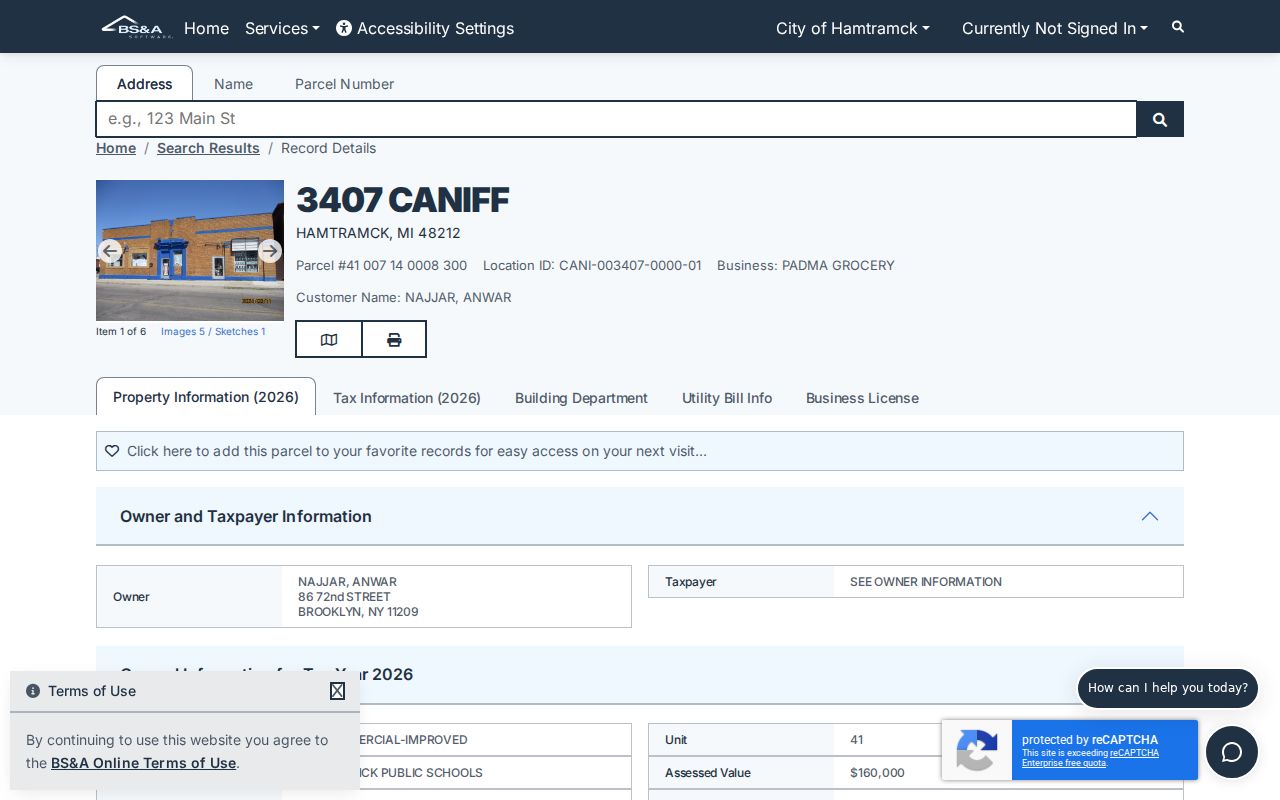
Those separate fields matter in practice. Keep the property address, owner label, mailing address, parcel number, and legal description as distinct facts when you copy them down.
Trace Wayne County Ownership Across Sources
Every official source answers one narrow question. When names conflict across sources, match on the parcel number or legal description first, and let the latest recorded conveyance outrank an older assessment snapshot.
| Source | Owner Info It Gives | Access |
|---|---|---|
| Municipal assessment roll | Owner of record, mailing address, situs, parcel ID | BS&A or local assessor |
| Register deed index | Grantor, grantee, instrument, recording reference | Free name list; paid expanded search |
| MiBusiness Registry | Entity identity, status, registered office and agent | Public state search |
| Parcel Viewer | Geographic parcel match and adjoining geometry | County interactive map |
| Treasurer listing | Tax status tied to address or parcel | County address/parcel lookup |
After a closing, the assessment owner and the deed grantee can disagree for a while. Wayne County publishes no single update interval covering every municipal roll. So note the date you viewed each source instead of trusting a fixed lag.
Use Wayne County Legal Descriptions as the Tie-Breaker
Names fail as identifiers more often than people expect. Spelling drift, shared surnames, dropped initials, and entity suffixes all blur the trail. Street addresses shift too, thanks to renumbering, annexation, subdivision, or lot combinations. The legal description is sturdier. It links the assessment result to the deed through a subdivision and lot, metes-and-bounds calls, a condominium master-deed reference, or a liber and page.
Parcel IDs work well as cross-system keys. But Detroit and the suburbs format identifiers differently. An ID can retire after a parcel split. Copy punctuation and leading zeros exactly. Then weigh both the parcel identifier and the land description before you decide who owns the property.
Identify Wayne County LLC, Trust, and Estate Owners
An LLC or corporation often appears as the deed grantee. No individual name shows in the owner field at all. MiBusiness Registry can supply the entity's exact name, status, and formation details. It also lists the registered office and resident agent. Those filings identify the legal organization only. They never prove that its agent or members personally own the parcel.
Copy trustee wording from the deed exactly as written. If you see "estate of," an executor, an administrator, or a personal representative, follow the Wayne County probate record path. Then return to the recorded conveyance. A probate event can transfer ownership without resembling an ordinary sale.
- Owner of record
- The party named on the current assessment roll.
- Grantee
- The recipient named in a recorded deed.
- Situs address
- The physical property location, distinct from the mailing address.
- Title
- The legal ownership interest, which an index result alone does not establish conclusively.
Resolve a Recent Wayne County Closing Gap
A freshly recorded deed can outrank a stale local roll. Search the latest grantee entry. Check its recording date and legal description. Set both against the parcel card's owner and last-sale fields. Still seeing a mismatch? Call the local assessor about the current roll. Ask the Register of Deeds about document access.
The free land-record search runs on names alone. Address, parcel or tax ID, legal-description, and liber/page searching belong to the on-demand service. Counter and mail searches remain alternatives. The office does not take search requests by phone or fax.
Note: A recently recorded deed may identify a transfer before the responsible city or township updates its assessment roll.
The on-demand land-record search is sold in 15-minute increments. It unlocks the address and tract-oriented routes the free name list omits. A counter property search carries a published fee. The fee is waivable for a personal residence when you supply proof. Copies and certification cost extra. Confirm the current fee schedule and appointment rules before you travel, since the Register announced service and recording-fee changes taking effect around 2025 and 2026.
Watch Wayne County Names with Property Alerts
Wayne County gives owners a quiet early-warning option. The Register of Deeds offers a free Neumo Property Alert. It is built around custom name or keyword notices. You can start one from a document you find. It flags later filings tied to a person or entity, including certain liens and releases. Keep its limits in mind: the service does not guarantee complete or uninterrupted notice. An alert alone never determines ownership.
The tool has roots in local fraud prevention. Wayne County's Mortgage and Deed Fraud Unit began in 2005. The associated land-record system became fully functional two years later, in 2007. Suspected deed fraud belongs with that county unit. A simple discrepancy should first be checked against the tax roll. Then check the recorded instrument itself.
Set alerts only after you have pinned down the right indexed name variants. Include the exact entity suffix, trustee wording, or alternate personal form found in the deed. Hosted notices can miss filings. Search the official land index periodically, not just your email.
Know What a Wayne County Ownership Lookup Cannot Tell You
A Wayne County ownership lookup answers one narrow question. A public result cannot establish who occupies a house, whether every interest or encumbrance surfaced, where a legal boundary lies, or whether the indexed party holds marketable title. Michigan's Address Confidentiality Program exists for qualifying people. It provides a designated address and mail forwarding, and a land-record search is not permission to seek that protected residential information.
Ownership is not occupancy. Use Wayne County owner records for lawful property research and due diligence, never to stalk, harass, intimidate, or harm anyone.
Different questions send you to different places. The present roll field lives in current Wayne County owner records. Earlier transfers belong in the previous-owner chain, and a certified deed or professional title examination is appropriate when the answer must support a legal or financial decision about the property itself.
Many filings change a property without changing its owner. Mortgages, assignments, discharges, easements, construction liens, and tax liens can all encumber the land. Treasurer data reveals delinquent-tax status. A tax account is still not a deed. Court dockets can point to foreclosure, quiet-title, partition, probate, or judgment activity. The Third Circuit's online record is unofficial, and filed documents must be requested from the Clerk. None of it replaces the latest recorded conveyance.
A record can sit offline. The documented counter, mail, archive, and written-records-request channels remain open when a portal offers nothing. A focused Michigan FOIA request should name the existing record, parcel, dates, and office. FOIA does not compel staff to answer a research question or create a title report.
The Treasurer offers another identity check. Its form takes an address or parcel ID. Leave the municipality blank for a countywide attempt, and try partial street-name searches. Detroit identifiers keep their punctuation and possible suffix. Suburban numbers usually drop the spaces and dashes. Always match the Treasurer result back to the municipal roll and the deed rather than treating the tax account's displayed name as proof of ownership.
Subdivision property rewards one extra step. Compare the lot and block with the recorded plat. For older irregular parcels, follow metes and bounds and the adjoining-land references in the deed. A GIS polygon can help you locate the land. The county warns that active parcel maps are maintained locally, so reference geometry cannot settle ownership or a disputed boundary. The same careful matching keeps a similar street address or a same-name owner from landing on the wrong parcel.